
Pearl is a different kind of AI network. It is a Layer-1 blockchain where the mining work is the matrix multiplication at the heart of every AI model, so the GPUs that secure the network are the same GPUs serving your inference. Bitcoin burns energy on hashes that do nothing else; on Pearl, that energy answers prompts. Its proof of useful work protocol, cuPOW, makes that computation verifiable at a cost Pearl measures at about 4 to 5% over a stock serving engine on DeepSeek V3.2 and Llama 70B. The result is open frontier models served by a decentralized pool of GPU miners who earn block rewards and inference fees for the same work, a design built to keep prices low and capacity growing.
Pearl's open models are now available through Shroud. Any 1Claw agent can call DeepSeek V4 Pro, DeepSeek V4.1 Flash, Qwen3.8 27B and GLM-5.3 on Pearl, with every prompt, answer and reasoning trace inspected on the way through, the same as every other provider Shroud supports.
There are three ways to pay for it. Bring your own Pearl key with the request. Keep that key in your 1Claw vault, so your agent never holds it. Or skip the Pearl account entirely and let 1Claw's key serve the call, paid from your 1Claw balance with credits or with USDC over x402.
What Shroud adds in front of Pearl
Open models are where a lot of agent work is moving: they are cheap to run at volume and easy to swap. They also bring the same risks as any other model, and an agent is a bigger target than a chat window. It reads web pages, emails and tool output written by strangers, and it can act on what it reads. Calling Pearl through Shroud puts a security layer between your agent and the model, on every request and every response:
- Prompt injection is caught before it reaches the model. Shroud strips hidden instructions tucked into markdown and HTML, normalizes look-alike Unicode, decodes Base64 and hex payloads, and scores the request for injected instructions and fake system prompts. A page that tells your agent to ignore its rules and send its data somewhere is flagged or blocked, not obeyed.
- Secrets never reach Pearl. Values from your 1Claw vault are swapped for placeholders before the prompt leaves, and Shroud also catches credentials that never came from the vault, like an API key pasted into a chat. Personal data such as emails, card numbers and SSNs is redacted the same way.
- Reasoning is inspected too. Reasoning models think out loud, which gives a secret a third place to surface. Shroud scans the reasoning text as well as the prompt and the answer, and still forwards Pearl's reasoning field so your code gets the trace.
- Responses are checked on the way back. An answer that echoes an injected instruction, hides an exfiltration link in a markdown image or data URI, points at an exfiltration URL, or contains something that looks like a credential is caught before your agent acts on it.
- Tool calls are inspected. When the model asks your agent to run a tool, the arguments are checked for shell command injection, sensitive file paths and data leaving the network, so a manipulated model can't quietly turn a tool into an attack.
- Policy lives outside the prompt. Each agent's allowed providers and models, daily spend cap and topic guardrails travel in its 1Claw identity and are enforced by Shroud. Nothing in a prompt can talk the agent past them.
- Every call is on the record. Each request lands in the agent's activity and the Spend tab, with what was redacted or blocked, so you can see what your agents sent and what came back.
Shroud also checks the request against the model's published capabilities before Pearl is called. Ask a model without JSON mode for JSON, or send an image to a text-only model, and you get a clear 400 instead of a paid failure. A model that is not in Pearl's current catalog is refused outright.
The API is OpenAI-compatible. Point your client at https://shroud.1claw.co/v1, add X-Shroud-Provider: pearl, and use Pearl's model id as is.
1. Bring your key
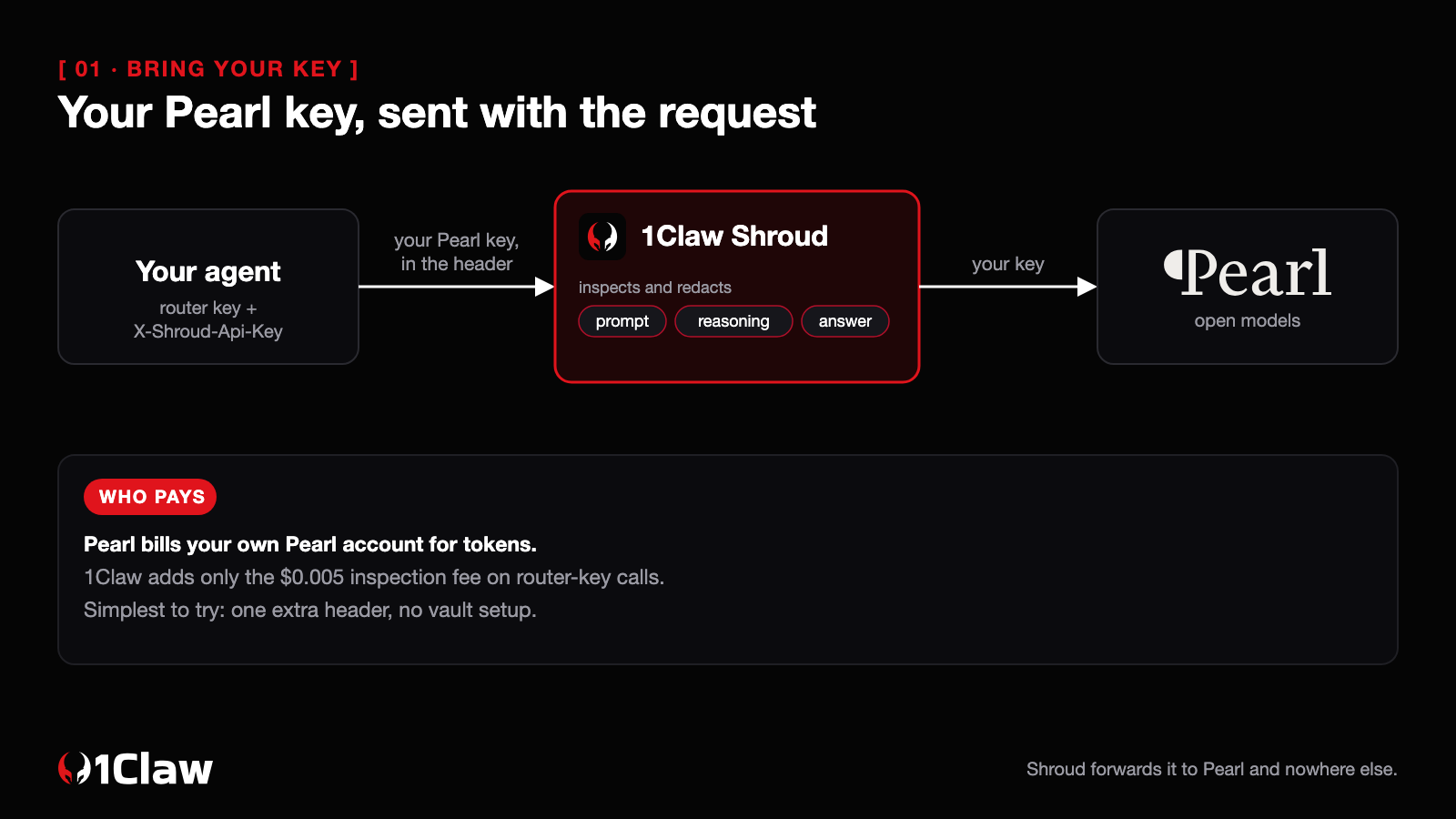
The quickest way to try it. Send your Pearl key in X-Shroud-Api-Key. Shroud uses it for that one request, sends it to Pearl and nowhere else, and Pearl bills your own Pearl account for the tokens.
curl https://shroud.1claw.co/v1/chat/completions \
  -H "Authorization: Bearer $SHROUD_ROUTER_KEY" \
  -H "X-Shroud-Provider: pearl" \
  -H "X-Shroud-Api-Key: $PEARL_API_KEY" \
  -H "Content-Type: application/json" \
  -d '{"model": "deepseek-ai/DeepSeek-V4-Pro-0813",
       "messages": [{"role": "user", "content": "Hello"}],
       "reasoning": {"effort": "high"}}'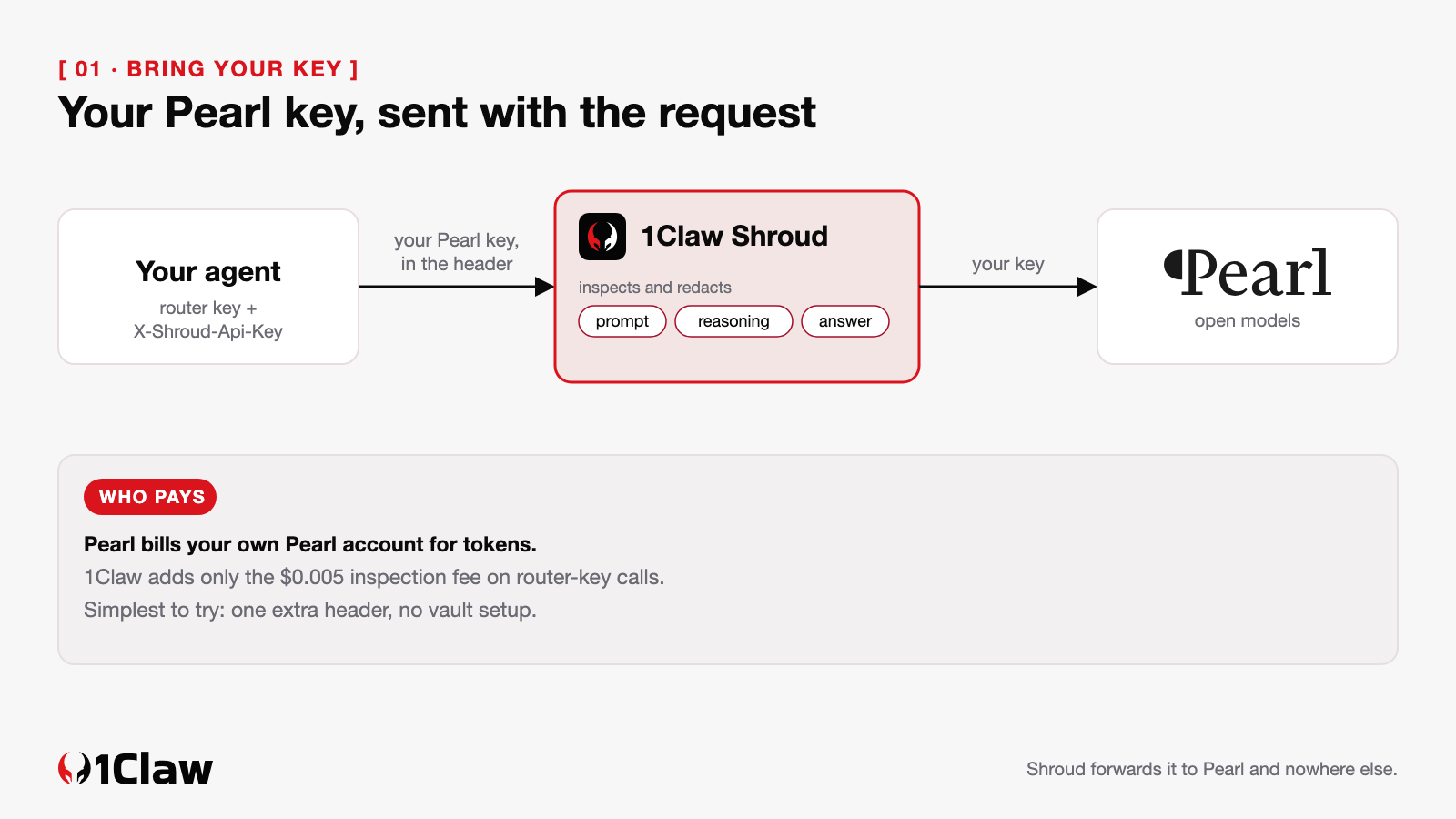
2. Keep the key in your vault
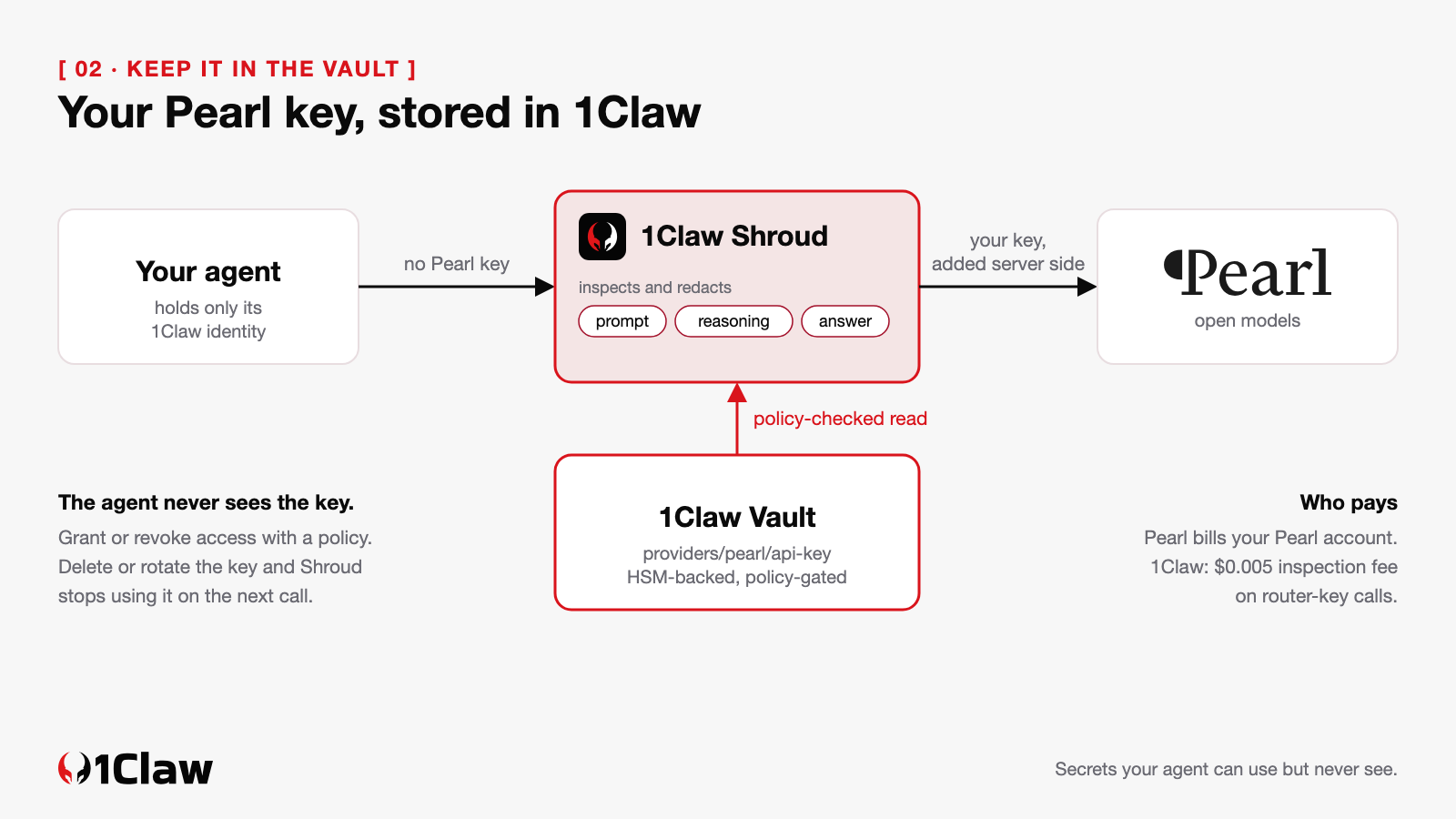
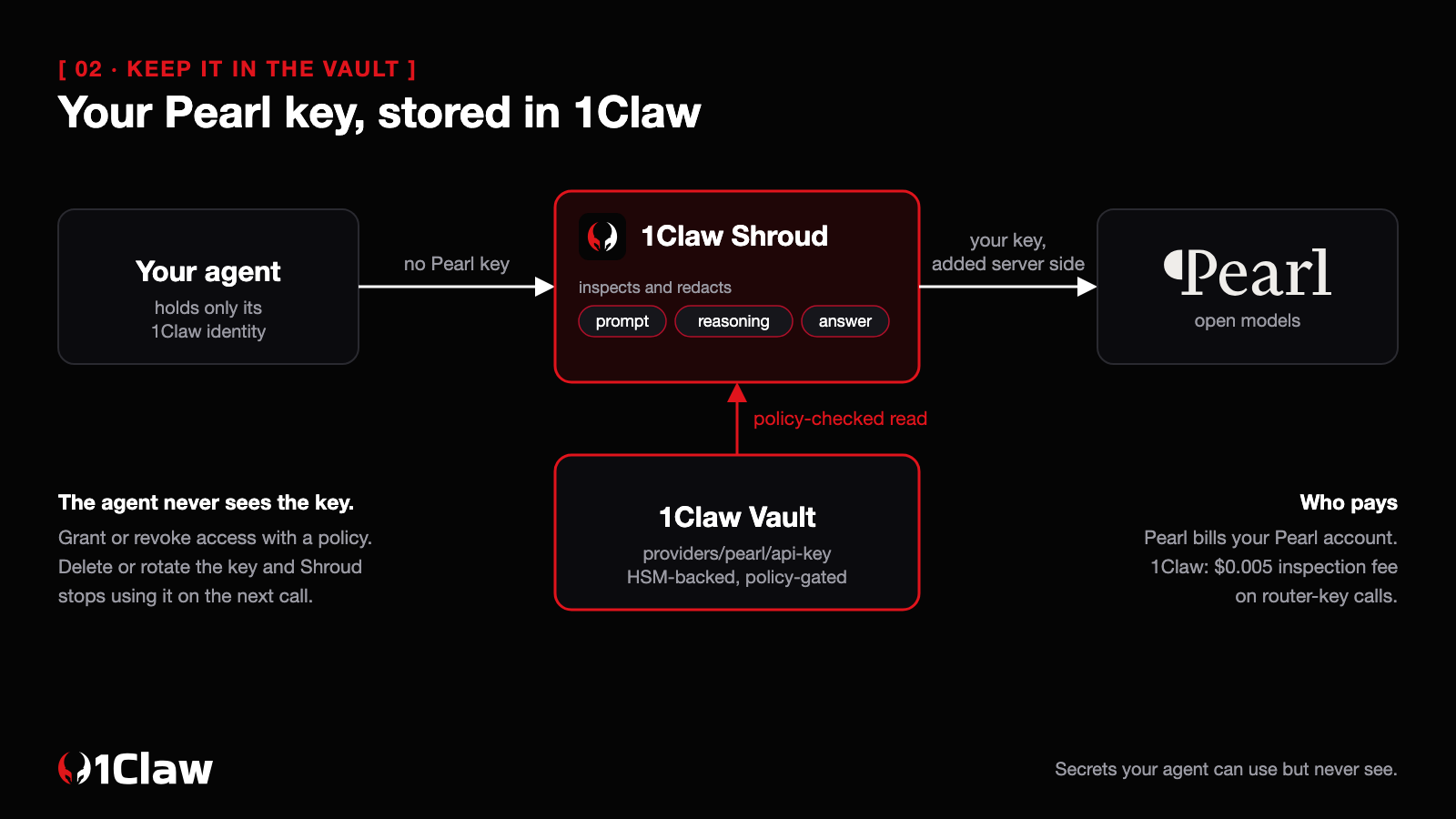
The better setup for anything long-running. Store your Pearl key once at providers/pearl/api-key in a 1Claw vault and grant your agent read access with a policy. Drop the header. Shroud reads the key from the vault for each call, and the agent only ever holds its own 1Claw identity. A prompt injection can't leak a key the agent never had.
Changes take effect on the very next call. When you store, replace or delete the key, grant or revoke access, or delete the vault, the vault tells Shroud before it answers you. Revoke access and the next request no longer uses your key. There is no cache window to wait out.
3. Use ours
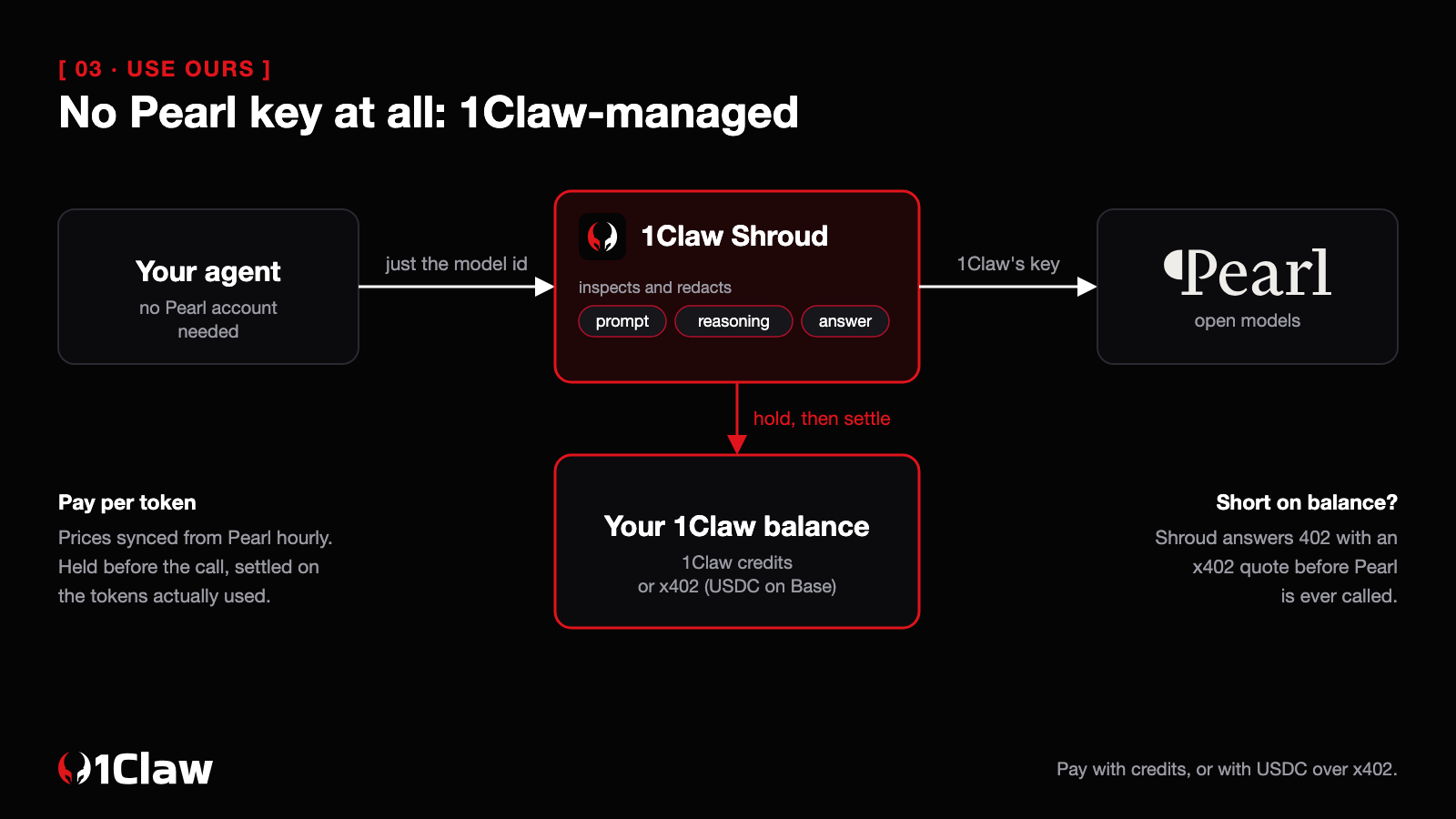
No Pearl account? Send no key at all. Shroud calls Pearl with 1Claw's key and charges your 1Claw balance per token. Top the balance up with credits by card, or pay with USDC on Base over x402. With x402 you don't even need a 1Claw account first: the first payment from a wallet sets one up and returns a router key.
Billing is held, then settled. Before calling Pearl, Shroud holds enough to cover the whole prompt plus your max_tokens. When Pearl reports what the call actually used, it charges that and releases the rest. If your balance can't cover the hold, you get a 402 before Pearl is called. On the x402 rail that 402 carries a quote you can pay and retry.
curl https://shroud.1claw.co/v1/chat/completions \
  -H "Authorization: Bearer $SHROUD_ROUTER_KEY" \
  -H "X-Shroud-Provider: pearl" \
  -H "Content-Type: application/json" \
  -d '{"model": "deepseek-ai/DeepSeek-V4.1-Flash",
       "messages": [{"role": "user", "content": "Hello"}]}'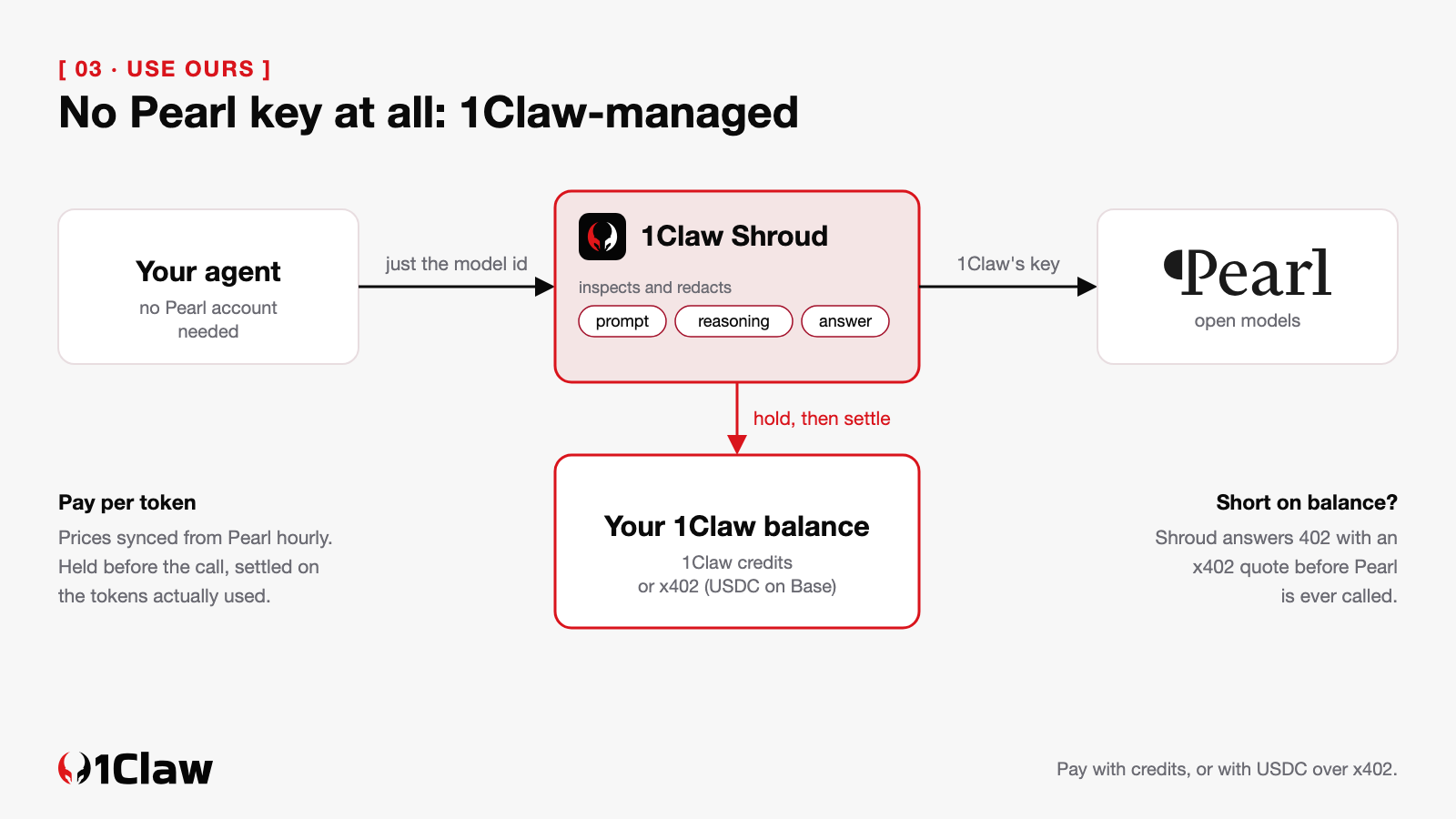
Prices you can check
Managed prices follow Pearl's own catalog, synced every hour. GET https://shroud.1claw.co/v1/models?provider=pearl lists every model you can call right now with the price you will pay, and the Spend tab in the dashboard shows the same numbers. If we ever fail to sync Pearl's prices for 24 hours, managed calls stop with a 503 rather than being charged at a guessed rate.
Every Pearl response carries an x-shroud-pearl-billing header, byok or managed, so you always know which key paid. Shroud tries your header key first, then your vault key, and only then 1Claw's. If the vault can't be reached during the lookup, Shroud returns a 503 rather than quietly billing the call to your balance.
Router-key calls pay the usual $0.005 inspection fee in all three modes. Agents using their 1Claw agent key don't.
Get started
The Pearl section of the Shroud docs has the full reference, and 1claw.co/for-ai has a snippet you can copy. If you already route an agent through Shroud, switching it to a Pearl model is one header and a model id.